
Imagine that you are the head of a public university or college in 2012. You are faced with an incredible set of challenges. While you know how critical your “product” is to the growth and development of society… economically and culturally … you are often a political pawn between the haves and have-nots. The elitists at the top of the hill pitted against the peasants down below. Folks, we’re in this together!
Amid uncertainty about the availability of public funding for post-secondary education when aging populations are starting to demand more health and long-term care, you are caught in the middle — your graduates are the innovators, entrepreneurs, leaders that will create the solutions to our fiscal challenges if only our governments can make the right investments today.
On top of this, your centuries-old campuses are tired. Your organizational structures were designed for a different time. And governance models can make it very difficult for you to change.
So… with these daunting challenges facing you (and your government leaders as well), where do you invest your finite dollars… which come partly from your students and their tuition fees, partly from your generous alumni and other donors, and partly from the taxpaying public in your neck of the woods, through Government funding?
The answer is simple. Invest in your product quality… Invest in the student experience… all else in your universe flows from there.
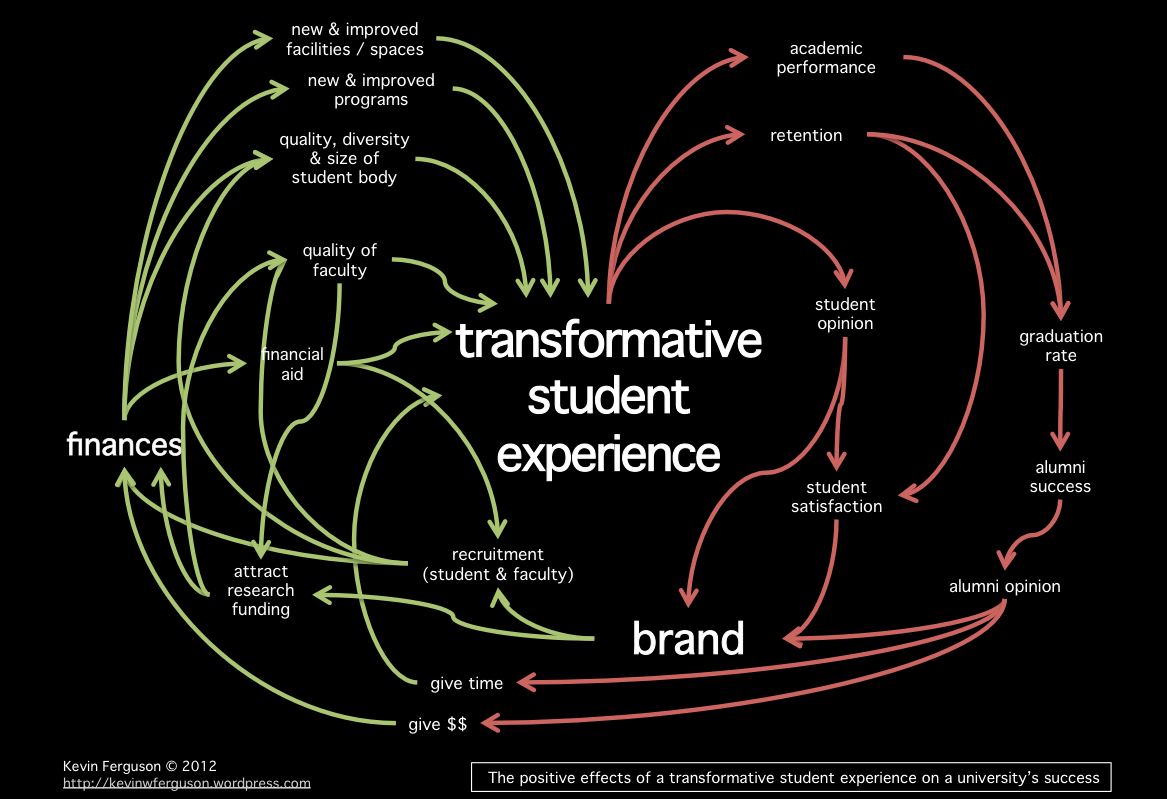
I sketched out this causal loop diagram to illustrate some ideas about a “transformative student experience” and the positives it creates. It isn’t perfect I’m sure, but you get the point. For a university or a college, the student experience, quite simply, is EVERYTHING. Build your vision around it, tell your story over and over, and get everyone passionate about it. And invest there — in building a transformative student experience. It’s the best investment you can make.
For governments, heed this thinking. While you have very real near-term issues to manage, the economic, cultural and social potential of your citizens rests on the return on the investments you are willing to make for the future.
 Ambiguity is your friend