
Change… Degree of Difficulty? Ask 2 questions

You’ve just been approached about a new assignment, maybe by client or even within your own organization.  They want your help in trying to implement a new travel & expense policy.  They know you’re good at communication, engagement and coaching so they’re hoping the “change management guru” (you) will lead them to the promised land of success.

I like to boil things down to simple terms so here are two questions you should have answered to inform your decision of whether or not to accept the assignment:

(1) Does the “leader” treat his/her staff with respect and dignity today?

There are a number of ways to get at this one.  I like to ask if I can review the most recent employee satisfaction survey results, related to the staff in question.  These usually contain data that can help you answer the question.  If you have an opportunity to interact with the staff directly, that can be a great way to get a feel (assuming they know you and would consider opening up to you).  If you can ask someone else who has done work for this organization, that can potentially answer the question as well.  Often times, though, you won’t have much opportunity to review data or interview people BEFORE accepting the assignment so you’ll have to resort to either asking your “client” a number of questions (around the topic) in hopes of triangulating to an answer.  Beware: you may have to be creative as you’ll often not get an honest or completely useful answer, especially to a very direct question, like it’s stated above.  Usually, your own perception and gut feel will have to come into play.

(2) If the answer is no, does the “leader” care?

You can go through several of the options above but much of this one will come to gut feel as well.

If the first answer was yes, the second was likely yes so this is a place that should be fertile ground for leveraging good “change management” (communications, engagement, coaching, training) to yield results.

If the first answer was no but the second was yes, it will be a difficult and painful road but there may be some hope because at least they care so maybe there’s a real willingness to do better (often, they’re not as willing as they’ll lead you to believe).

If both answers are no… in my experience, this is a bad assignment to accept, unless you’re in search of martyrdom or only in it for the short-term money. Very rarely will this environment be one that can make the transition. The only way they’ll be able to find any degree of success is through brute force, command and control style management. There’ll be lots of collateral damage and the results won’t be where they want them. And it will look badly on the poor change practitioner that couldn’t make it a success. My advice is to run! … If you want to help them, tell them precisely why you’re not accepting the work…

Most projects aren’t long or patient enough for even the best change management approaches or practitioners to be able to fix deep-rooted issues like a lack of respect, dignity, trust, happiness, etc. If the organization is a crappy place to be, they need a lot more than a change management “guru”.

Truth about 21st Century Motivation

“There’s a mismatch between what science knows and what business does.”

Today, I’m revisiting Dan Pink and his book “Drive: The Surprising Truth About What Motivates Us”.  I posted about it a couple years ago after I’d seen an RSA Animate video about it.  Since then, I’ve referred to the book several times in my life as a “change agent” and have seen or heard several of the author’s talks, available on the web.  Pink’s research takes aim at many of the assumptions business leaders have held for more than a century in motivating their people.  His central thesis is that in the 21st century, intrinsic motivators “autonomy, mastery and purpose”… not extrinsic motivators like rewards and incentives… are the building blocks in a better way of doing things — productivity, performance and engagement go UP… turnover and worker dissatisfaction go DOWN.

This makes so much sense — carrots and sticks may have worked in a world when we all blindly said “yes sir” to our supervisors whenever given an assignment or an “order.”  But in the 21st century, a time when accountability reigns supreme, don’t you find that workers ask “why?” more than ever?  That’s because they want to “add value”… they’re on the hook for the outcome… Their cred is on the line … We all want to understand why before we say ok to an assignment.

In this presentation from TEDGlobal 2009 in Oxford, England, Dan Pink focuses on autonomy … enjoy.

What motivates us?

Good question I think.  What motivates me probably isn’t the same thing that motivates you. If you posed that question to a group of executives, what answers do you think you’d get?  My guess is a mix of frank, down-to-earth answers and textbook, jargon-laden ones.  If you asked your friends, what would they say?  Would you get any serious answers at all?  I was curious so I conducted the following highly sophisticated and wicked scientific bit of research.  On my Facebook wall, I posted the question “what motivates you in your work life?”… Here are some of the comments I received from friends:

Beer at lunch; Fridays; getting to the bar as quickly as possible; where I work!; early retirement; 5pm; people; being in the know; taking care of the team; summer holidays!

Surprise… a few weren’t serious.  Maybe I should say a few were.  And as the list illustrates, people are looking forward to their time away from work.  Notably absent?  Money.  I would have expected at least one joke about money being the only motivator.  When I was in university (what we Canadians call college), someone gave me a key chain that said “Money isn’t everything… but it’s way ahead of whatever’s in second place.” (I went to school during the late 80s… Wall Street (i.e. the movie) attitudes were pervasive in business schools).  Were they trying to tell me I had no heart… no soul?  Anyway, I was a little surprised not to even see the word money appear in any of my friends’ responses to my question.

Earlier this year, I picked up a book called “Drive: the surprising truth about what motivates us” by Daniel Pink. I’ve cracked it open but not yet had the time to read it (I’m still reading this and this… by the way, this is worth reading too).  A little while back, our CEO sent me the following video, related to Dan Pink’s “Drive” …

Pretty interesting.  Although a lot of us intuitively get it, I guess I was a little surprised (not to mention a lot impressed) that autonomy, mastery and purpose far outpaced money as a motivator.  I’m sure you, like I, have come across managers who think it’s all about money.  And that would explain how the so-called conventional wisdom is not at all aligned with what’s really going on.  So, is money completely unimportant?  Personally, I don’t think so.

I think underlying all of this is the question of fairness… At our core, we all want to be treated fairly.  When it comes to our work lives, part of that fairness is pay.  Now, for most people, I think money does become secondary as long as the “fairness principle” I’ve noted is satisfied.

“So what?” you ask.  I’ll quote my 2nd year HRM professor… “We can’t motivate someone else to do anything… all we can do is create an environment that facilitates someone in motivating themselves.”  Money is one piece of the environment that a manager creates for his or her team… as are autonomy, mastery and purpose… and a lot of other things.

If you want your people to be motivated… you need to do a lot of things right… before they even begin to motivate themselves. Not easy… but entirely necessary, if you care at all about long term success.

Update: 8/10/2010: 11:43pm ADT… A new FB friend just commented on my question: “Am i the only greedy one in the bunch – it’s the paycheck baby!”… There’s always one…

Who comes first – employees or clients?… take deux!

A couple months ago, I posted “Who comes first – employees or clients?” I was throwing a question out there but my central belief is that organizations should look at employees as their most important component.  If you take care of your people, they will take care of your clients.  My original post came on the heels of an exercise (and ensuing discussions) that we were undertaking in my company to define our core values.  First, let me update that story… We successfully created 6 core values… chief among them?  “Employees First.”  Now, anyone will tell you that the words only mean something if the senior leadership of the organization actually walk the walk.  I agree.  But we have taken an important first step by calling it out for the entire company to see and buy into.  That’s good stuff.

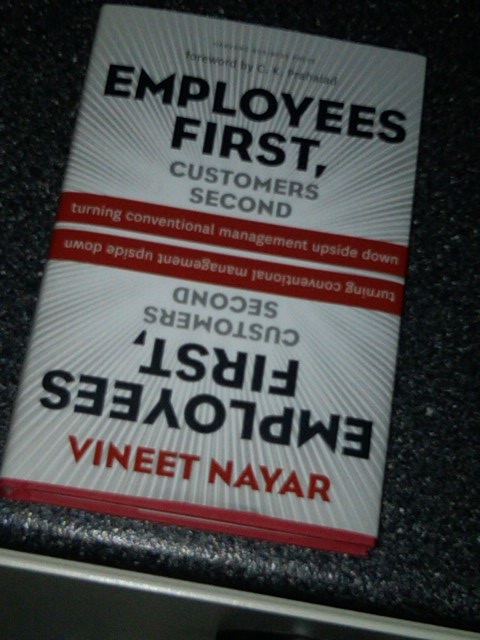
Shortly after this process concluded, I came across a new book that is right on the money.  As the photo above beautifully illustrates, the book is called Employees First Customers Second (EFCS for short).  In it, author Vineet Nayar, CEO of HCL Technologies, one of India’s largest professional services firms, describes the program he implemented at HCL (‘acronymed’ EFCS) and how it transformed the organization in a way that strengthened its foundation for growth.  He refers to the value zone… where employees meet and interact with customers to create value… as being the most important ‘zone’ for a company.  And he uses this as the basis for needing an Employees First mindset because value is created by them, in the trenches, on the front lines, at customer sites… not by executives and managers sitting, often times, far far away.  The best way to create value for your customers is to enable your employees.  It all rings true… at least from my experience.

I’m only halfway through but I have to admit I felt some level of vindication when I first came across this book.  It was nice to know that my thinking about “employees first” was shared (and with a global CEO and author at that).  And since I’m an organizational change guy, EFCS is already giving me all kinds of great ideas… especially for creating a culture of change – something all organizations are absolutely starving for.

Employees First Customers Second… Is it revolutionary?  I’m not sure.  Could it create a revolution in the way managers think?  Yep, it sure could… and I hope it does.

A means to an end…

I read an interesting post a little while ago… Change Management – a means to an end.” The author was making the point that organizational change practitioners should stop trying to convince their clients that ‘change management’ is necessary because change management is a means to an end… results!

I couldn’t agree more.

Management consultants have the opportunity to play a very effective role as trusted advisor to their clients.  However, a lot of clients are just looking for someone to implement what they’ve already decided.  And too often, the consultants comply (I encourage you to read my July 2009 post “We don’t hire consultants for advice“).  Consultants should resist blindly saying “yes” to a client’s order and focus on ensuring that value is created through whatever project or engagement is in play.  I don’t know about you but I’m not interested in being an order-taker.  There’s one of those on every street corner.  And if you follow the order and fail… guess what? You still failed.  And let’s not kid ourselves… the client didn’t fail, you did.

We should initiate all our early client discussions with their aspirations and goals as the context and push for a deep understanding of the benefits (results) they’re seeking.  Everything should flow from that… strategies, tactics, actions, deliverables, tasks…

Unfortunately, I think we’re often speaking a different language when we talk about change management methodologies… it’s academia, theory.  If we aren’t doing that, well, we’re probably viewed that way.  And I think it’s a more acute problem for organizational change practitioners.  We’re viewed as soft HR types.  In many cases, that’s probably a fair characterization.  But in many others, it’s not.  I describe myself as an accidental change practitioner.  I have a decidedly analytical bent to me (because of my early training as a strategy and process consultant).  But I also have a deeply rooted HR side to me; a real belief in the need to inspire people, to create an environment in which they’re motivated to do great things (even when that involves big change).  It’s these complementary perspectives that (I think) make me an effective consultant because I am always searching to fuse analysis with inspiration… analytics with messages… reality with vision.

Too often, our clients don’t really understand what ‘change management’ is… even though you’ll get about 200,000,000 search results for it on Google.  And at the end of the day, it doesn’t matter what ‘change management’ is.  It’s not important.  What is important is that you help your clients find the right path to success.  And although we may know that the path to success must be paved by “people”, success will only be marked by the achievement of results… the realization of benefits.  As an entrepreneurial finance prof used to say “It’s in the numbers!” (actually he said “numbahs” but that’s a story for another day).  And that, my friends and colleagues, is the only thing that should matter… for you and your clients.

Are we addicted to “different”?

Right now, there is a never-ending supply of organizations that are trying to reinvent themselves. Right now.  Everywhere I go, I hear people talking about the changes they want to make.  My clients talk about the transformation they’re embarking on.  My colleagues talk about the adjustments we need to make to… “get to the next level.”  Everything I read is about the dynamic world we live in and how those organizations who can innovate fastest, smartest, and for the least cost, will “win” in the next decade (I’m not sure how different that concept is today than, say, 50 or 100 years ago).

And this addiction began long before the recent financial meltdown.  It has been going on for at least as long as my career.  In earnest, it probably began in the early 90s with the advent of IT as an enabler of our businesses.

I do not use the word addiction lightly though… I believe we are addicted to change.  I think we are obsessed with tossing out the other guy’s model in favor of implementing our own… with very little regard to the fundamentals of good decision-making and sound investment.  And that’s a huge problem… for your employees, your customers, your partners, the communities you serve and support, and your shareholders.

Why is that a huge problem?  Because most of us suck at implementing change.  Yeah, I said it.  We, collectively, are horrible at it.  Don’t believe me?  Look around… How many articles are out there talking about the percentage of projects that fail?  It’s in the order of 2/3 to 3/4.  That is a staggering number.  And it should worry all of us… as shareholders, customers, employees, … even as taxpayers.

Don’t believe the hype?  It’s all propaganda right?  I don’t think so but fine.  Take a look around your own company.  How many changes have been attempted and either shelved, completely failed, or simply ended up like so many – in an ocean of mediocrity?  That’s all the evidence you should need to care.

The fact is… we’re addicted to ‘different.’  We don’t always know what we want or where we want to be… but we know it’s somewhere or something else.  And our addiction leads us down dark paths that often don’t end well (or don’t end at all).  So let’s do ourselves, our colleagues, our customers and our investors a favor.  If being ‘something’ or ‘somewhere’ else is important, then make it happen.  But make sure it sticks.  Because change that sticks creates value.  And change that doesn’t stick… well… I think you already know the answer.

Insomnia is wonderful…

It’s 5am on the Atlantic coast of Canada and I’ve basically been up all night.  Maybe it was the two espressos after dinner.  Or maybe I just have too many things on my mind for sleep to take hold.  Consuming my thoughts tonight and this morning has been social media and how I can leverage it in my world.

[Back story…]

In early 2007, I finally joined the Facebook band-wagon.  At the time, I did it as a lark to see how quickly I could amass 100 friends.  It didn’t take that long and it was kind of fun.  Today, I’m just shy of 400 friends (yes, they’re all people I know) and while I can’t say I use FB a lot, I do find it interesting to connect with people I’ve known but whom are now scattered around the globe.  And I’m not the only one… isn’t it the most popular social media venue on the planet?

Fast forward to mid-2008… one of my best friends joins a local firm called Radian6 (I know you’ve heard of them)… They’ve developed a tool that crawls through the web, mining data from social media sites for its clients (apologies for my lay explanation of your business, folks).  I think Radian6 has a lot of potential and I hope they do well.  Anyway, my friend (not a social media type at the time) says I need to get on Twitter.  My first question?  What the hell is Twitter.  He tries to explain but it’s no use.  I really don’t get it.  Who cares what I’m doing?

I continue to be intrigued by this Twitter thing…

Then, this summer (2009), I see a webcast featuring Guy Kawasaki, founder of Alltop.  He’s explaining how he uses Twitter as a means of sharing what he believes to be valuable or interesting information.  The lightbulb went on… I read a ton… I can use this…  I can become a purveyor of information too.  So, I started tweeting… Then, I decide to start this  blog.  Admittedly, I still haven’t found a comfort zone.  Neither have yet become part of my being… YET.  But I’m learning and I’m enjoying the learning so that’s good.

[End of back story]

So how can I use social media to help my clients?  Let’s start with what I do.  I can most simply be described as a management consultant.  Specifically, I’m an expert in leading change.  Change?  That’s a pretty generic term – what the hell does that mean?  Great question.  Here goes (proceed with caution – a consultant is about to describe what he does)…

Every day, organizations initiate change… it could be the introduction of a new product, the pursuit of a new market, the restructuring of roles and responsibilities, a merger or acquisition, the implementation of a new business process, or the deployment of a new system.  Just a few examples.

You may not know this (although intuitively you probably do)… Most organizations are horrible at implementing change because it is hard.  It’s hard on the people who have to change.  And the typical result is a lot of wasted time, money, and energy because the benefits do not come, the competitive advantage does not materialize, and the customer satisfaction does not improve.  These are why you set out on a path to change in the first place… So if you aren’t getting the payoff, why did you do it?

What I do is help clients get it right…  I see it as a piece of their investment management or risk management. I work with them to design strategies and tactics to properly deploy change and, most importantly, make it stick!

So back to my original question – how can I leverage social media in my world… to facilitate the “stickiness” of change?  While social networks are quickly transforming the way friends interact, they are and will continue to evolve the way colleagues interact as well.  While some people (even in “older” industries) are embracing social media, I think many (my gut says most actually) organizations and their leaders are lagging way behind their employees.  Traditional (or more aptly dated) forms of communication and engagement – emails, web sites, newsletters, face-to-face meetings for example – are becoming less effective with each passing day.

To try and get ahead of the curve… I’m trying to become more savvy about social media so I can help clients adapt their engagement practices in a way that captures their employees’ interest, imagination and enthusiasm.  Engagement is perhaps the most critical success factor not only for leading change but also for fostering and sustaining high performance.  And as we adapt our ways of interacting, we also need to adapt the way we engage each other.

Hmmm… it’s late (or rather early)… I hope I haven’t rambled too much.

If you have any advice, I’d welcome some thoughts on this… And thanks “Gus”, from Radian6, for pointing me toward Twitter… Although I’m still a novice, it has started me on the path to understanding social media, how it’s changing our world, and how I can leverage it to create value for my clients.

“It’s the product, stupid”… or is it?

For the better part of a decade, I worked for a large technology company based in the greater Boston area.  When I joined in 1998, it was already a good size organization (~6,000 employees) with most of the power and influence being wielded out of two areas – Product Development (aka Engineering) and Sales.

The company was, first and foremost, a product company.  In large measure, we made great products and had a hell of a sales team that could close deals.   The road to product leadership had been paved primarily by a breakthrough product family that was a game changer and revolutionized the industry.  And the master mind behind that product line was revered like a god.  And rightly so, his design was instrumental in our ability to topple some of the world’s technology giants in the industry.

But… you can become too focused on how great your product is… In fact, I can remember being at a company “all-hands” meeting at which ‘said’ god was speaking.  He had just been named a fellow of the company and was giving a brief speech.  As he was finishing up, he raised his fist in the air (kind of pumped it) and said “it’s the product, stupid.”

What the hell does that mean?  I didn’t get it.  None of us (my contemporaries anyway) got it.  We just looked at each other with an “is-that-an-in-joke-that-none-of-us-are-in-on?” look.  Over the next couple days, we went looking for the reference… Clearly this had some meaning somewhere.  And it did.

We discovered that it had been a phrase used historically, in a “tongue-in-cheek” kind of way to explain why the company was so successful.  “It’s the product, stupid!”  How could you even ask the question… you idiot?!!  Ha ha ok I get it now.

At the time, I just found it lame… But upon some reflection, it really started to annoy me. (editorial note: I don’t believe there was any intent to offend anyone or even to be overly provocative… but it really got me thinking)

“It’s the product, stupid.”

“It’s the product, stupid.”

What about “the people?” What about you and me and everyone else?  Don’t we have something to do with the success of the company?

Don’t we have ideas that lead to new opportunities, initiatives, markets?  Don’t we conceive of products, design them, build them?  Don’t we market them, sell them, deliver them, and support them?…Heck — isn’t it people who BUY your products?

If your focus isn’t on people, how do you get anything right?

It’s the people, stupid.

<this event marked the beginning of my gradual shift toward a specialty in organizational leadership and change>

Do you have a sense of urgency?

Creating a sense of urgency is a necessity if you are to implement successful change in your business. Why? Well, for starters, a sense of urgency from a C-level sponsor creates the initial boost needed to give birth to a new initiative. That boost can help ensure the project kicks off on the right foot (strong sponsorship and commitment, proper funding, and the right resources dedicated to the project). It can also provide a kick in the pants where needed.

But most of all, in my experience, a sense of urgency creates energy. It creates an atmosphere that motivates people. It brings excitement. It creates something to connect to and gather around. A sense of urgency also inspires us to do something, to do it better, to do it smarter, to do it now!

Great — so how do you create a sense of urgency? I like to use business cases or cost-benefit analyses. Business leaders like, no scratch that, they need to understand the analytical rationale for agreeing to pursue something new — a new product, a new market, a new system, a new process… A business case helps you to articulate what’s happening in your business, what needs to change, how it ought to be changed, the benefits of doing it, and the costs to get there (giving you some semblance of an ROI). Granted, high-level estimates often leave much to be desired but a business case can get people excited… create belief in the story and form the basis for a sense of urgency to do something about it.

John Kotter, author of Leading Change and a pre-eminent authority on organizational transformation, believes (and I happen to agree) creating a sense of urgency is critical to successful change. The video below is a 2008 interview with Kotter in which he gives his insights on urgency and how to create it… Take a look.

“You can’t play Jenga with a house of cards…”

It was a Friday in July of 2006; it was about 1pm on a hot and humid day in greater Boston.  I was just finishing my 12th consecutive month of weekly travel (and feeling a little irritable).  I was the change leader for a very large CRM implementation.  Bill was the Program Director, Bob was the Business Lead and Tony was the Partner from our integration partner.  “You can’t play Jenga with a house of cards,” remarked Bob… (reminder below)

Jenga

The back story… We were in month 16 of an 18-month odyssey to bring a new CRM system to 5000 professionals located in every corner of the world.  In many ways, the project was a success story.  We had strong sponsorship.  We had (mostly) adequate funding.  We had (moderately) a solid team.  We had excellent engagement and commitment from stakeholders, especially from our field organization (probably the best I’ve ever been involved with).  System development, on the other hand, had been bumpy; forever behind schedule.

On the Friday morning before we’re scheduled to kick-off end-user training in London and Munich… we’re notified that our training environment (shoddily built by the way) has crashed.  They’re confident they can get it back online in time for training on Monday.  What do you do?  (note: this was not the first environment issue this project had experienced).

The discussion we’re having is (A) what to do about next week and (B) what to do… period… about training.  Our training program was developed on a model of direct practice in the system.

“You can’t play Jenga with a house of cards.”

The system and its instability was the house of cards…

I was extremely “bearish” on this system.  Had been for some time.  There was always something problematic with it… And we’d gotten a big black eye during our train-the-trainer program when we reluctantly used the development environment to conduct hands-on training. I had the pleasure of being in a classroom full of senior folks in Paris when our system crapped out.  Sorry doesn’t really cut it.

As the leader of the change team, the front line to the users, my team and I were feeling the wrath of anxious users who’d been burned by IT projects before.

So what did we do?…We cancelled the next week’s training… another mis-step would have erased what little confidence our users had in the system.  As I said, they’d been burned before by past projects.  That would have been a disaster for the $30M program.

Early the next week, after 72-hours of work by our tech team, we made what would turn out to be the best under pressure decision we made on the project.  While our tech guys were saying “everything should now be fine,” we weren’t convinced.  We scrapped the entire 5-week training program and set out on a plan “B”.  In short — 2 words: do over.

We replaced an instructor-led, classroom-based model with a completely web-based program.  In the span of a few days, we developed a “good enough” product to bring to the masses.  And build a new support model to provide coaching and assistance — user-led training isn’t as rich in content so we expected more support would be needed by our users.

It was a tremendous collaborative effort between business people, subject matter experts, IT folks, our trainers, extended project team, power users and our core team.  And, to paraphrase my now “former” brother-in-law… “it all worked out.” (it didn’t for him… hence the “former“).

Reasons for success:  (1) we gathered as much information as we could in the short time we had, (2) we were rational about what “could” be done – we did not try to be heroic (like many project teams do when faced with a critical issue), (3) we were honest with our stakeholders about what happened and how we would fix it (and we apologized to them for the inconvenience our issues had caused them and their teams), (4) we worked day and night to make it right, and (5) we thanked and rewarded the team of people who made it happen.  I had a lot of thank yous to our process leads, their teams, our consultants, and my team…

As with anything related to change – you have to put people first.  If you do that, and always do it, a lot of good things fall into place.  And while you still have a lot of work to do, you’ve got people working together toward the goal.