
Expect the Unexpected

If all organizations were really good at expecting the unexpected (and preparing for it), we wouldn’t need people who specialize in helping organizations to change successfully.  The reality, however, is that few organizations are good at this. 

I continue to encounter client organizations for whom “expect the unexpected” is still a common phrase yet they really don’t live by those words in their every day.  And that’s a real shame because I think, as human beings, we’re actually pretty darn good at living by those words in real life.

I’d like to look at an every day example of how people deal with the unexpected – the weather.  Most of us check the weather forecast whenever we’re planning to go outside… for a bike ride, to walk around downtown, or head out of town for a long weekend getaway.  And if the forecast looks less than ideal, we plan for it… we wear a jacket, bring an umbrella or pack rain gear.  And if the forecast turns out to be correct, well, we deal with it.  Expecting the unexpected is key to life.

I’d like to share a story about a camping trip in Bar Harbor, Maine that featured a tent and an unexpected rain storm. The year is 2009 or 2010 and as I recall, we had delayed our trip by several days because the forecast expected thunder showers for most of the week but was calling for clear skies with a 10% POP for the next four days. My brother and his family went early anyway (they have a pop-up trailer) and the weather turned out to be fine for them… until we arrived.

Our drive down was a stormy one and we were a bit concerned about what we’d find at our destination. We found cloudy but not rainy (that’s good when you have to set up a tent and a kitchen shelter).  The next day was a beauty – we spent the day in Acadia National Park.

It was a perfect day – sunny and hot.  We played soccer, paddle ball, dug holes and body surfed in the chilly North Atlantic. At about 3pm, however, the weather turned cool and cloudy (quite quickly) so we decided to pack it in.  Within minutes of hitting the road, there was rain on the windshield.  I’m thinking “This is great, just great!”  We got back to the campground and the rain didn’t seem too bad so we got cleaned up and headed into town to find dinner and a movie at Reel Pizza (a movie house that serves pizza).  By the time we arrived it was absolutely pouring.  Crap!  And Reel Pizza’s feature had changed from G-Force (guinea pig spies… great for kids) to Public Enemies (for kids? Not so much).  Crap again!!

We managed to find parking and then a pizza joint (Epi’s)… when you have 5 kids in tow (that’s both families not just mine) and it’s coming down in buckets (and you’re re-setting expectations — “sorry, guys, no movie tonight”), you’re looking to find cover and food quickly.  The pizza was good and the atmosphere authentic New England pizzeria.

After we finished (it was only 6 o’clock) so we decided maybe we’d find a movie in a neighboring town.  But first a stop at the campground to commiserate.  We decided to skip the movie (showtime was 8:00 – not great for the 3- and 5-year olds in our clan) and returned to our sites.  I was concerned about the state of my tent anyway — and for good reason.

When we got back, the kids settled into my brother’s trailer with the portable DVD version of Finding Nemo and I checked the tent.  Crap, yet again!!!!  Water pooling in the corners, duffle bags moist, sleeping bags and pads soaked.  Thanks to Coleman for that awesome rainfly.  After much effort, my bro and I got it taken care of — we bought a 10×20 tarp, covered the tent, pegged it down… Wendy took the sleeping bags and pillows to the on-site laundry facility and the rest, as they say, is history.  In the end, we responded well and managed the situation successfully.  The Shipyard IPA, Gritty McDuff’s Vacationland Ale, Miller Chill and Geary’s Summer Ale didn’t hurt things.  Our final couple days in Bar Harbor were perfect.  We can’t wait to go back.

Our reason for success – (1) we have lots of experience camping, (2) cool heads prevail, and (3) it helps to have a sense of humour.  Although we didn’t expect rain, it’s camping and we understand anything can happen.  We expected (sort of) the unexpected even if we weren’t fully prepared for it.

Did I mention that on the way into Bar Harbor (on day 1) I said to my wife “Maybe I should pick up a tarp”.  I had tossed mine a few years ago after it had gotten beat up after years of use (I’ve been tempting fate ever since and this weekend, fate made me pay).  And then I said those famous last words “Nah, we’ll be fine.”

Sound familiar?  How many times have executive sponsors made that statement when deciding whether or not to invest some project dollars in much-needed but often under-valued activities like communications, stakeholder engagement, training and good long-range planning?  “Nah, we’ll be fine.”

And how many times has that turned out to be a good decision?…

That’s what I thought you’d say.
2. “Know what the shot is”

“You wanna learn the first rule… you’d know if you ever spent a day in your life… You never open your mouth till you know what the shot is.” – Ricky Roma

If you’ve seen the movie Glengarry Glen Ross*, you may remember that one.  True, it’s not as legendary as Alec Baldwin’s speech but it points out a valuable lesson when it comes to transformation and change.  It’s an excerpt from a rant by sales rep, Ricky Roma (played by Al Pacino), to his business manager (John Williamson played by Kevin Spacey), after Williamson blew a sale by jumping, uninvited, into a conversation Roma was having with a prospect.  Williamson thought he was helping but in truth he didn’t know enough of the background or the relationship to know what really was going on. Watch (note: explicit language)

“Knowing what the shot is” is critical when making decisions in your organization, especially those which will have an effect on people… so you know, pretty much every decision you make.  When you’re starting a new project or venturing into any new territory, it is important to make sure you get a lay of the land before you dive in.  I know this sounds like common sense but do you really do it?  I’m going to say “probably not.”

Yeah, you think about it – you might even talk to a few others in the “decision-making” pay grade to see what they think.  But the answers are usually the same.

“Well, there’s never going to be a perfect time to do this so let’s just get going.  We’ll close the gaps as we go.”

Sound familiar?  This is what decision makers say all the time, right?  Unfortunately, it’s a cop out (and I’m not sure you realize it).  They’re right that there’s rarely a perfect time for change (whether it’s the introduction of new programs, products, or services or the deployment of new technologies, policies, processes or the restructuring of something that exists already).

I’m not suggesting for a second that we put our ideas on hold so we can put together a blue ribbon panel to spend more time investigating.  Not at all.  What I am saying is that you need to be smart about what you’re doing and being smart means “knowing what the shot is.”

Maybe you know your organization really well already.  Yes?  Then use that knowledge and insight as a lens for your planning.  It’ll help you to figure out how to get things done successfully.

And if you don’t already know the shot.  Spend some time and effort right now to get that figured out.  It’ll pay you back in spades down the road.  Trust me.  When you know what the shot is, then you’ll know what moves to make, and not to make.  And that’s key to getting things right.

* I haven’t seen the play so I can’t confirm the specifics of the Roma Rant on stage.

1. “We’d like to do change management in stealth mode”

Not kidding.  A client said this to me one time.

—–

Have you ever been on a project where you had budget, people, ample time and seemingly the will to kick some serious ass, but the client or sponsor was constantly saying… “not yet…”??

A number of years ago, I was doing work for a government client – I was the change management lead for a major system implementation.  I was brought in on the late side of early, which is to say we still had a couple years to go but the project was already a couple years old (maybe it was the early side of late).  Bottom line – there was still plenty of time to  get ready but the horse was already well out of the barn.

One of the first things I wanted to do was an organizational assessment – I wanted to get an understanding of both the culture that existed within the user community and the state of any communications-to-date (which were extremely limited) … had they had any impact (positive or negative).  Within a month, we were ready to rock and roll.  The Project Director, Executive Sponsor, Business Owner had all okayed it and we were about to get going.

Then the stall tactics came.

The only thing we were waiting for was for a senior-level bureaucrat to push out a communique to launch the assessment.  It was drafted and approved.  Literally waiting to hit “send.” And this was the process we had to follow to launch this program — as a consultant, I really couldn’t do it myself and neither the PM nor Project Director were willing to break protocol.

Not yet.

For those of you whom have worked in a government environment, you can appreciate how decisions are made and how slow the pace can be.  Did I mention an election was coming too.  From what I’ve seen, a pending election drives one of two main behaviours:

(1) everything stops until after the election

(2) everything is jammed in before the election

I was in scenario (1).  But no one was saying that.  Anything that required communication was basically put on the back-burner, unofficially of course.

Not yet.

A big part of managing change is communicating so obviously this was frustrating for me and my team.  For the next several months, we did a lot of planning but very little execution.  There was a lot of stalling and growing concern that we were not doing the things we needed to be successful in the long term.  And this was being brought to our steering committee’s attention on a regular basis.

Not yet.

One day, I pulled the Project Director aside and asked him what was going on.  His answer?

“We’d like to do Change Management in stealth mode.”

I was blown away.  “Stealth mode?” I asked.

“… just for a couple more months until the (new) Government’s first budget is passed,” he added.

Holy cow! (these weren’t my exact thoughts)

So what did I say?  I told him that change management is anything but stealth.  We need to talk about what’s happening and why.  We need to spend time asking people what they think and how they feel about the new direction.  We need to observe and listen… and answer questions.  We need to brag, we need to get people on board, we need to lead. He needs to lead.

When I finished my rant, I calmly reminded him that delays will pose great risk to the success of this project and that if he was willing to take that risk, it was his call.  But my advice was to not take that risk, for his sake or for the organization’s.

We had a major communication out the door within 2 weeks of that conversation… and the rest is history, fortunately.

Going into “stealth mode” is the enemy of change.  And that makes it the enemy of success.

Change… Degree of Difficulty? Ask 2 questions

You’ve just been approached about a new assignment, maybe by client or even within your own organization.  They want your help in trying to implement a new travel & expense policy.  They know you’re good at communication, engagement and coaching so they’re hoping the “change management guru” (you) will lead them to the promised land of success.

I like to boil things down to simple terms so here are two questions you should have answered to inform your decision of whether or not to accept the assignment:

(1) Does the “leader” treat his/her staff with respect and dignity today?

There are a number of ways to get at this one.  I like to ask if I can review the most recent employee satisfaction survey results, related to the staff in question.  These usually contain data that can help you answer the question.  If you have an opportunity to interact with the staff directly, that can be a great way to get a feel (assuming they know you and would consider opening up to you).  If you can ask someone else who has done work for this organization, that can potentially answer the question as well.  Often times, though, you won’t have much opportunity to review data or interview people BEFORE accepting the assignment so you’ll have to resort to either asking your “client” a number of questions (around the topic) in hopes of triangulating to an answer.  Beware: you may have to be creative as you’ll often not get an honest or completely useful answer, especially to a very direct question, like it’s stated above.  Usually, your own perception and gut feel will have to come into play.

(2) If the answer is no, does the “leader” care?

You can go through several of the options above but much of this one will come to gut feel as well.

If the first answer was yes, the second was likely yes so this is a place that should be fertile ground for leveraging good “change management” (communications, engagement, coaching, training) to yield results.

If the first answer was no but the second was yes, it will be a difficult and painful road but there may be some hope because at least they care so maybe there’s a real willingness to do better (often, they’re not as willing as they’ll lead you to believe).

If both answers are no… in my experience, this is a bad assignment to accept, unless you’re in search of martyrdom or only in it for the short-term money. Very rarely will this environment be one that can make the transition. The only way they’ll be able to find any degree of success is through brute force, command and control style management. There’ll be lots of collateral damage and the results won’t be where they want them. And it will look badly on the poor change practitioner that couldn’t make it a success. My advice is to run! … If you want to help them, tell them precisely why you’re not accepting the work…

Most projects aren’t long or patient enough for even the best change management approaches or practitioners to be able to fix deep-rooted issues like a lack of respect, dignity, trust, happiness, etc. If the organization is a crappy place to be, they need a lot more than a change management “guru”.

Yoda: Jedi Master or Change Guru?

My kids have recently rediscovered the magic of Star Wars.  When we were away camping in Maine a couple weeks ago, they, along with their cousins, broke out the light sabres and started duelling around the campsites… It was actually pretty fun to watch.

When we returned home, they spent their first two days reacquainting themselves with the 6 movies (in order… for the full effect of Anakin Skywalker’s transformation from young Jedi to Darth Vader).  When they were watching Episode 1: The Phantom Menace, I overheard one of Jedi Master Yoda’s most famous quotes…

“Fear is the path to the dark side.  Fear leads to anger, anger leads to hate, hate leads to suffering.”

According to one online source, this is his meaning (my abridged version):  “Negative emotions are a result of fear. Understanding what we are afraid of is where we begin to conquer fear, and therefore anger and hate.  If we look at the things we hate or that make us angry… and ask why, it will usually lead back to a lack of understanding, and in turn, fear of the unknown.”

You know, Yoda’s teachings on the force and the ways of the Jedi could easily be applicable to strategies for managing organizational change.  So much of our resistance to change is about fear of the unknown, uncertainty, lack of understanding… or anger about something we like being displaced or taken away.  And don’t forget the resentment felt toward those in leadership positions or in the roles of “change agents”.  If we focus more on addressing fear and anger, I’m certain we’ll see better success rates for change initiatives.

If we were to recast Yoda’s words into something like this…

“ambiguity leads to fear… fear leads to anger… anger leads to resentment… resentment leads to inertia… and inertia is the path to maintaining status quo (i.e. failure to change).”

… we might be able to put ideas together to really address the things at the heart of the matter when it comes to change.  And let me give you a hint – it ain’t requirements, specs or better features.  Think people, spirit, enthusiasm, and feelings…  That’s the stuff of change!

“Ambiguity is the path to the status quo.”

Find the Bright Spots

You’re trying to implement change… but you’re getting quite a bit of resistance.  Of course you are, that’s to be expected.  You do what seems natural… you immediately raise the issue within the team and now it’s “all hands on deck” to analyze the situation and solve the problem.  Workshops ensue (“we need to brainstorm on how to complete the analysis and eliminate the resistance”… “maybe we should interview the resistors.”).  Hold it right there!

Rather than focus on the problems and the resistors… try looking for the bright spots, the successes, the supporters… the good stuff.  Gain insight and understanding about why your seeing success.  Then, try and duplicate that… again and again and again.  Props to Chip and Dan Heath, authors of Switch: How to Change Things When Change is Hard.  Check out Dan Heath in this video on Finding the Bright Spots.

http://youtu.be/zbLNOS7MxFc

Do your employees trust you? Without it, change will be messy.

For the past few weeks, I’ve been pouring much of my energy into developing a change strategy for my client (they are a large government organization engaged in a fairly large transformation with both technology and business change implications).

When I’m writing something as dry sounding as a strategy document, I like to write it for consumption… not for a shelf… so I want it to have life and have soul.  So, I will take a look around for sources for inspiration – be it words of wisdom, little nuggets or even a creative visual for my deliverable.  If I can find old speeches from well-known people, it can usually be a good place for quotes, meaningful messages, and, generally, insightful words.  And a credible source adds credence to my story.

As I was pulling together thoughts for this strategy, I remembered something from Steve Jobs’ speech at Stanford’s 2005 Commencement (disclosure: I saw it on YouTube not by crashing the ceremony in Palo Alto… though that may have been fun).  If you’ve never seen or heard it, check it out:

In his speech, Jobs relates three stories from his life… the first (which covers the first 5:30 or so of the video) is about “connecting the dots.”  He talks about how it’s impossible to connect the dots in your life when looking forward… you only do it when looking backward.  And that you have to trust that somehow the dots in your life will connect… and trusting in that makes all the difference as you make choices that may take you off “the well worn path.”  This seems like common sense, right?  Not rocket science?  Of course not… it seldom is.  It’s so simple that we can easily miss it when we’re in the middle of our own situation.

It got me thinking about how important trust is in an organization… As employees, we place a great deal of trust in our managers because their ability (or lack thereof) to make good decisions will have a direct impact on us and the people who trust in and count on us.  Trust is equally important when considering change — new processes, new systems, new products or services, new strategies, markets, …

When I begin work with a new client, one of the first areas I explore is the culture of the organization… do people like each other, do they like working here, do they trust each other and do they trust in their management.  If the answer is “no” to any of these questions, it’s a big ol’ red flag.  I can tell you with near certainty that change is going to be messy so brace yourself and do something about it.  Because if people don’t trust those whom are driving the change, they will not be able to, as Steve Jobs did, “trust that the dots will somehow connect” and they will be very unlikely to want to venture away from the “well worn path” that is their job as they know it today.

So, please… managers… do the things you need to do to create a trusting culture in your organization… because when the time comes for you to consider implementing change that will impact your people (yeah, that’s who it affects by the way… people… not an impersonal, inanimate object that we call a company or organization), you will spend fewer hours, less energy, and less money in a trusting culture than you would in one that lacks trust.  And, hey, who knows, people will probably be smiling most of the way.  But if people don’t trust you, they won’t change my friend… I’m sure you’ve lived that one before…

What motivates us?

Good question I think.  What motivates me probably isn’t the same thing that motivates you. If you posed that question to a group of executives, what answers do you think you’d get?  My guess is a mix of frank, down-to-earth answers and textbook, jargon-laden ones.  If you asked your friends, what would they say?  Would you get any serious answers at all?  I was curious so I conducted the following highly sophisticated and wicked scientific bit of research.  On my Facebook wall, I posted the question “what motivates you in your work life?”… Here are some of the comments I received from friends:

Beer at lunch; Fridays; getting to the bar as quickly as possible; where I work!; early retirement; 5pm; people; being in the know; taking care of the team; summer holidays!

Surprise… a few weren’t serious.  Maybe I should say a few were.  And as the list illustrates, people are looking forward to their time away from work.  Notably absent?  Money.  I would have expected at least one joke about money being the only motivator.  When I was in university (what we Canadians call college), someone gave me a key chain that said “Money isn’t everything… but it’s way ahead of whatever’s in second place.” (I went to school during the late 80s… Wall Street (i.e. the movie) attitudes were pervasive in business schools).  Were they trying to tell me I had no heart… no soul?  Anyway, I was a little surprised not to even see the word money appear in any of my friends’ responses to my question.

Earlier this year, I picked up a book called “Drive: the surprising truth about what motivates us” by Daniel Pink. I’ve cracked it open but not yet had the time to read it (I’m still reading this and this… by the way, this is worth reading too).  A little while back, our CEO sent me the following video, related to Dan Pink’s “Drive” …

Pretty interesting.  Although a lot of us intuitively get it, I guess I was a little surprised (not to mention a lot impressed) that autonomy, mastery and purpose far outpaced money as a motivator.  I’m sure you, like I, have come across managers who think it’s all about money.  And that would explain how the so-called conventional wisdom is not at all aligned with what’s really going on.  So, is money completely unimportant?  Personally, I don’t think so.

I think underlying all of this is the question of fairness… At our core, we all want to be treated fairly.  When it comes to our work lives, part of that fairness is pay.  Now, for most people, I think money does become secondary as long as the “fairness principle” I’ve noted is satisfied.

“So what?” you ask.  I’ll quote my 2nd year HRM professor… “We can’t motivate someone else to do anything… all we can do is create an environment that facilitates someone in motivating themselves.”  Money is one piece of the environment that a manager creates for his or her team… as are autonomy, mastery and purpose… and a lot of other things.

If you want your people to be motivated… you need to do a lot of things right… before they even begin to motivate themselves. Not easy… but entirely necessary, if you care at all about long term success.

Update: 8/10/2010: 11:43pm ADT… A new FB friend just commented on my question: “Am i the only greedy one in the bunch – it’s the paycheck baby!”… There’s always one…

Who comes first – employees or clients?… take deux!

A couple months ago, I posted “Who comes first – employees or clients?” I was throwing a question out there but my central belief is that organizations should look at employees as their most important component.  If you take care of your people, they will take care of your clients.  My original post came on the heels of an exercise (and ensuing discussions) that we were undertaking in my company to define our core values.  First, let me update that story… We successfully created 6 core values… chief among them?  “Employees First.”  Now, anyone will tell you that the words only mean something if the senior leadership of the organization actually walk the walk.  I agree.  But we have taken an important first step by calling it out for the entire company to see and buy into.  That’s good stuff.

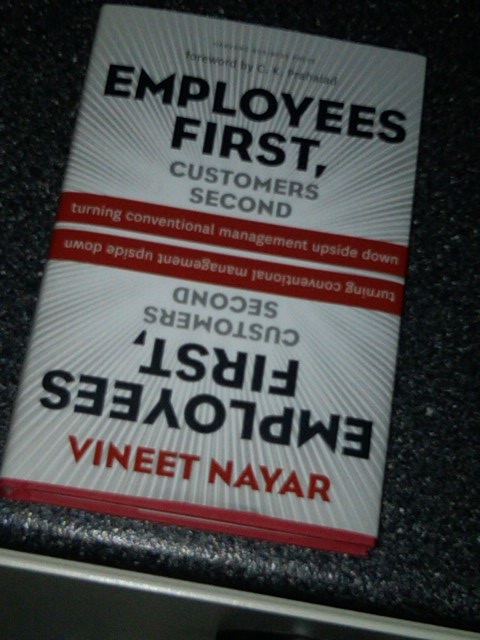
Shortly after this process concluded, I came across a new book that is right on the money.  As the photo above beautifully illustrates, the book is called Employees First Customers Second (EFCS for short).  In it, author Vineet Nayar, CEO of HCL Technologies, one of India’s largest professional services firms, describes the program he implemented at HCL (‘acronymed’ EFCS) and how it transformed the organization in a way that strengthened its foundation for growth.  He refers to the value zone… where employees meet and interact with customers to create value… as being the most important ‘zone’ for a company.  And he uses this as the basis for needing an Employees First mindset because value is created by them, in the trenches, on the front lines, at customer sites… not by executives and managers sitting, often times, far far away.  The best way to create value for your customers is to enable your employees.  It all rings true… at least from my experience.

I’m only halfway through but I have to admit I felt some level of vindication when I first came across this book.  It was nice to know that my thinking about “employees first” was shared (and with a global CEO and author at that).  And since I’m an organizational change guy, EFCS is already giving me all kinds of great ideas… especially for creating a culture of change – something all organizations are absolutely starving for.

Employees First Customers Second… Is it revolutionary?  I’m not sure.  Could it create a revolution in the way managers think?  Yep, it sure could… and I hope it does.

A means to an end…

I read an interesting post a little while ago… Change Management – a means to an end.” The author was making the point that organizational change practitioners should stop trying to convince their clients that ‘change management’ is necessary because change management is a means to an end… results!

I couldn’t agree more.

Management consultants have the opportunity to play a very effective role as trusted advisor to their clients.  However, a lot of clients are just looking for someone to implement what they’ve already decided.  And too often, the consultants comply (I encourage you to read my July 2009 post “We don’t hire consultants for advice“).  Consultants should resist blindly saying “yes” to a client’s order and focus on ensuring that value is created through whatever project or engagement is in play.  I don’t know about you but I’m not interested in being an order-taker.  There’s one of those on every street corner.  And if you follow the order and fail… guess what? You still failed.  And let’s not kid ourselves… the client didn’t fail, you did.

We should initiate all our early client discussions with their aspirations and goals as the context and push for a deep understanding of the benefits (results) they’re seeking.  Everything should flow from that… strategies, tactics, actions, deliverables, tasks…

Unfortunately, I think we’re often speaking a different language when we talk about change management methodologies… it’s academia, theory.  If we aren’t doing that, well, we’re probably viewed that way.  And I think it’s a more acute problem for organizational change practitioners.  We’re viewed as soft HR types.  In many cases, that’s probably a fair characterization.  But in many others, it’s not.  I describe myself as an accidental change practitioner.  I have a decidedly analytical bent to me (because of my early training as a strategy and process consultant).  But I also have a deeply rooted HR side to me; a real belief in the need to inspire people, to create an environment in which they’re motivated to do great things (even when that involves big change).  It’s these complementary perspectives that (I think) make me an effective consultant because I am always searching to fuse analysis with inspiration… analytics with messages… reality with vision.

Too often, our clients don’t really understand what ‘change management’ is… even though you’ll get about 200,000,000 search results for it on Google.  And at the end of the day, it doesn’t matter what ‘change management’ is.  It’s not important.  What is important is that you help your clients find the right path to success.  And although we may know that the path to success must be paved by “people”, success will only be marked by the achievement of results… the realization of benefits.  As an entrepreneurial finance prof used to say “It’s in the numbers!” (actually he said “numbahs” but that’s a story for another day).  And that, my friends and colleagues, is the only thing that should matter… for you and your clients.