
Who comes first – employees or clients?

So… clients or employees?  Which comes first?  This has been a source of some debate in my company for a little while and it has gotten me thinking… is one more important than the other?  Should one come ahead of the other?  Is this just another version of the age old chicken and egg story?  Maybe.  Maybe not.

Let me first give you some context for the discussion we’re having around this.  We’re a young company and we’ve just concluded an exercise to define our core values and guiding principles. [I will write a post on this one soon].  We took a very inclusive and consultative approach to defining them… starting with a small group of senior types brainstorming values that mean something to us (it was basically a list of ‘words’ we like)… Integrity, Excellence, Innovative, Creativity, Trust, … you can probably guess many of the others.  Like I said… words we like!  Who doesn’t like those?

One of the ‘values’ raised wasn’t very well-defined but had, largely, to do with the importance of our company ‘being good’ to employees.  The value we landed on was employee-centric.  On its own, it doesn’t have much meaning but the point was to articulate that it was important that the company be ’employee centric’ by caring about employees and the things they care about — an inspiring working atmosphere, learning and professional development, as well as their personal goals, ‘hierarchy’ of needs, wellness, well-being, and so on.  As a group, we were ok with something as nebulous as ’employee-centric’ because we knew what it was supposed to mean and believed it was important.  We thought it was self-evident although not well-defined.

The next step was to take these ‘words’ (I had a tough time calling them values at that point) to the proverbial street – that is, to the staff across the company.  Each person had the opportunity to provide input by essentially voting for the words (values) they liked best (and even adding new ones if they felt something was missing).  And the result was the following:
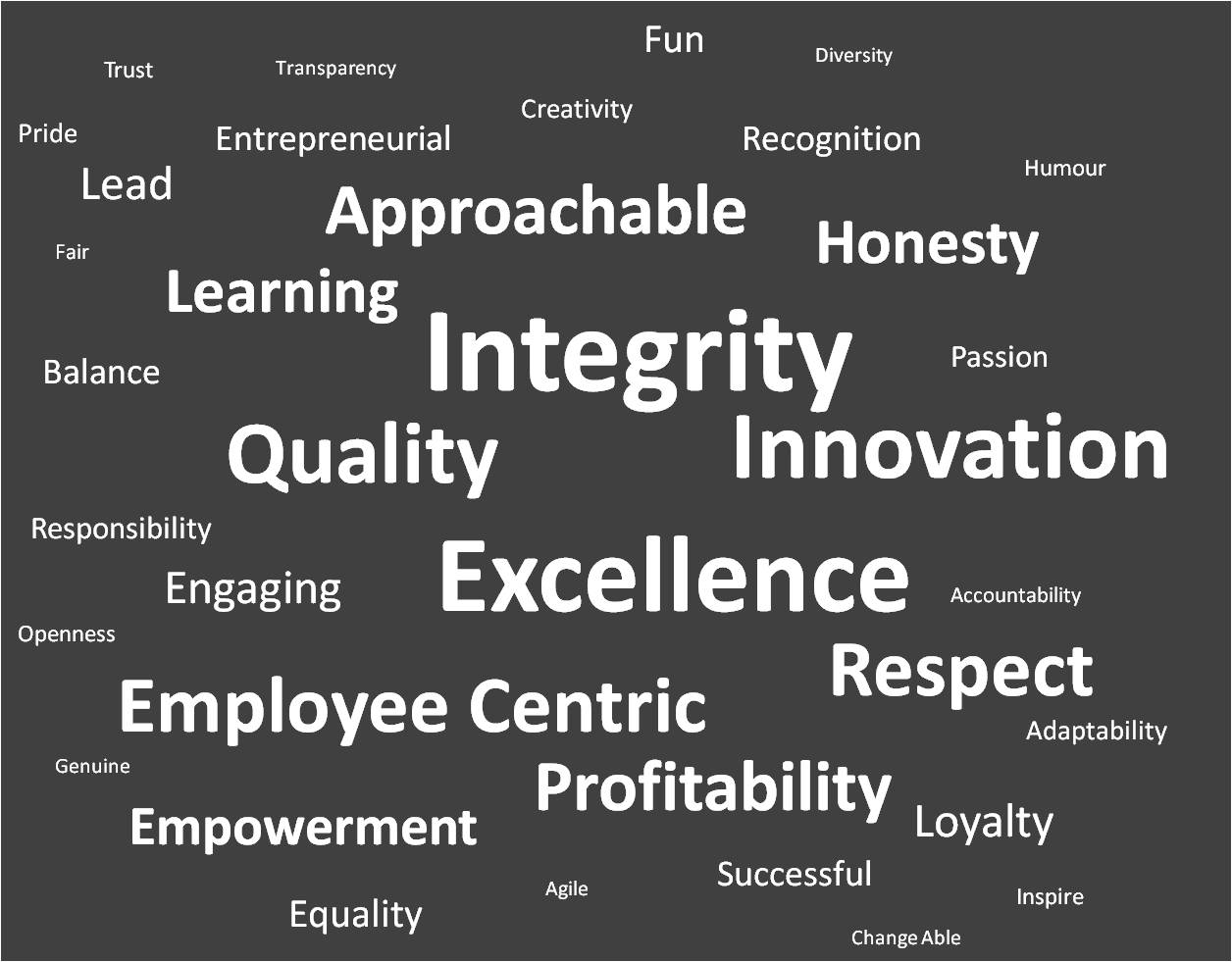
We felt pretty good about our new ‘value cloud’.  The larger the word, the more votes it had received.

I know I know… so where’s the debate?  It’s coming up… now.

The next step was to take the value cloud and some draft wording around guiding principles to the partners for discussion, approval, rejection, or modification.  A discussion ensued which probably shouldn’t surprise anyone…

“Why do we not aspire to be as client centric as we are employee centric?”

Great question.  But the only answer myself and a couple others could muster was [something like this]… “Without employees who are engaged, enthusiastic, passionate, creative, entrepreneurial, innovative, and incredibly talented, we do not have a company.  If we take care of our people, they will take care of our clients.”  Therefore, employees come first.  [Sounds good, right?]

There was some hesitation on the other side of the table… a little discomfort with where this was going.  And the conversation started to go the other way… “Without clients who are buying our services and thus creating the revenues that allow us to operate, there is no company.”  Same logic, used from the other side.

Hmmm… stalemate?  This conversation went on for a few weeks…

What do you think?  Is it possible to say one is more important than another?  Is it just chicken vs. egg and, therefore, subject to opinion?  Or is one a more foundational aspect of a company and its success than the other?  Please weigh in.
Fear is over-rated. Just make it happen!

It has been a long time since my last post… 15 days to be exact.  [ I have to hand it to all of you who can find something to say every day… Not just something but something good.  Kudos to you!]

I’ve had a bit of trouble finding inspiration… I could give a whole host of excuses – life has been too busy (like all of you aren’t busy too)… work has really ramped up. Over the course of the past 2+ weeks, I have started several posts…

One was my personal 9/11 story… it was surreal to be living in America (in Boston) as a Canadian on that day and during that time.

Another, though, began (and finally got finished in this one) as a tribute to Terry Fox who faced the adversity of cancer in his teenage years and lost the battle after an unfathomable display of courage and commitment for a 20-year old boy.  If you don’t know the story, take a look at the video (thanks to ESPN via It’s a Running Thing).

What did Terry achieve by embracing the unknown?  By taking on ambiguity?  For starters, he raised a lot of money for cancer research ($340 million and counting) and brought visibility to the disease and how it affects its victims.  More globally, his actions kicked off  a movement that took off far beyond, I am sure, anything Terry could have imagined.  The annual Terry Fox Run is the world’s largest one-day fundraiser for cancer research.  Terry Fox believed he could change the world.  And he has.  Terry Fox believed he could make a positive impact.  And he has.

He was an entrepreneur of sorts – he identified an opportunity, took initiative to seize it, assumed responsibility, and made it happen.  Is there a better example of an entrepreneur?  He was also a hero and is one of Canada’s greatest icons.  Every Canadian knows who Terry Fox is.  And many of us can remember exactly where we were when he was forced to end his historic run across our great country.  I know it sounds so cliche but I was actually playing road hockey [Damn, that sounds lame and predictable].

What can we learn from this in the context of our own lives and pursuits?

  • Fear is over-rated.  Be confident in tackling the unknown.  Take risks.
  • You’re more capable than you think.  You ARE smart enough.
  • Find purpose above yourself.  Believe in a vision and a cause.  Put others first.
  • Make it happen.  Act.

If we all followed the example set for us by an unknown kid from British Columbia, who happened to have a prosthetic leg and probably still had cancer, when he decided to embrace the unknown by running a marathon every day (for 143 days and 5,373km) so that he could make a difference for others… wouldn’t the world be a better place?

Once you accept that ambiguity is your friend… must be your friend… there’s little that will stop you.  Thank you, Terry Fox.

Look forward… embrace the unknown…

I’m a looking forward kinda guy.  I don’t get caught up with things that have already happened or those that are out of my control.  I get excited thinking about the possibilities and try to embrace the unknown…

An every day example… how about birthdays?  You celebrate the milestone and embrace the unknown future.

Yesterday (last night at 11:17pm Atlantic time to be precise), I turned 40 (or as my grandfather would have said, I “entered my 41st year”).  For many, this milestone represents a major turning point – it can often trigger the beginning of’ mid-life, soon to be followed by ‘crisis.’  Although I must say that most of my contemporaries handle 40 with a good sense of realism, some are truly traumatized by it.  To be clear, I am not.

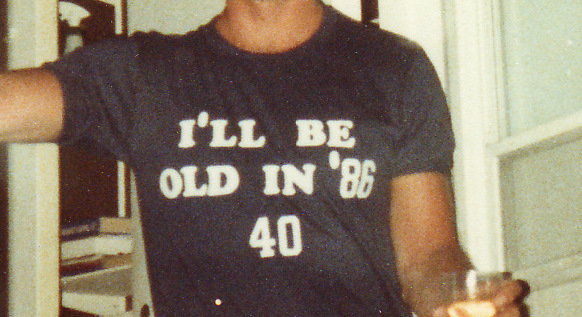
Does it feel a little weird?  Indeed.  But not because of the age itself… I’m really not (nor have I ever been) worried, scared or concerned about getting older.  No, it’s because of my memory of when my father turned 40.  I remember it well because I was almost 17.  [interesting background… when my aunt turned 40 – the year before my dad (her brother-in-law), she gave my dad a t-shirt that said “I’ll be old in ’86.  40.”  It was a great gift and is what, for me and my brothers, became the lasting image of our dad at 40… actually 39. ]

Dad at 40

It’s hard to believe that’s me now… actually a year ago.  When I think of when he turned 40, it’s not that he seemed old… it’s just that he seemed, I don’t know, older than I seem today.  I mean, come on, he was a father of three kids.  So am I.  But I still feel, in some ways, like I’m a young man.  Dad seemed way more responsible and mature than I am now.  He had to have been – he had 17-, 15-, and 13-year old boys.  My kids are 10, 8, and 5.

Knowing dad, he’d tell me he wasn’t any more mature or responsible (or father-like) than I am today.  Perspective is everything, right?  He’s my dad… he’ll always be the one with sage advice, wisdom and a great sense of humour.  That’s just the way it is.

I have my own children now who (just maybe) look at me the same way.  And you know what?  They don’t think I’m old.  Yesterday, I was told in no uncertain terms, by my 8-year old son, that I won’t be old for another 30 years.  Apparently, the age of 70 marks the point at which someone becomes a “geezer,” according to them anyway.  That’s good enough for me.

As I move ever closer to the top of the proverbial hill, it’s refreshing to know that I’m still 30 years from reaching the summit.  I guess to a child, their dad never seems too old (except maybe when they’re in their teens and battling about YOUR rules and THEIR independence)…

Whether it’s me remembering my parents at 40 or my kids looking at my wife and I today… 40 just isn’t old (I am resisting the many cliches I could use here… you’re welcome!).  And I’m looking forward to the next chapter.  i don’t know what it will bring but I do know it won’t be defined by my age… it’ll be defined by what I choose to do, why I choose to do it, whom I do it with and how I do it.  The last 40 have been great — the next 40 will be even better.