Happy New Year!

As with many of you, I’m entering 2010 with a number of resolutions.

1. Get in shape

2. Eat more fruits and veggies

3. (Re) discover my professional passion

4. Write more often

I will continue to update you on my progress with resolutions 1-3 and this blog will serve as the barometer for how I’m doing on #4.

I took a long break at the end of 2009.  My last post was November 27th.  I didn’t have a single post in December.  That’s pretty bad.  But I needed the break… not because I’d been writing so much but because I had lost my (what’s the word?) mojo.

I think I have it back so stay tuned because 2010 is going to be a better year here at “ambiguity is your friend.”

Work does imitate life…

Do you remember this book?  Who am I kidding?  Of course you do.

I don’t know if these are still published but several years ago (maybe 10?), these physically small books were everywhere… Barnes & Noble, Hallmark, CVS, Wal-Mart… I’ll bet you could even find them in some Starbucks, 7-eleven or Toys R Us too.  And you know they’d be in a bin at TJ Maxx.

They contained little passages that might move us in some way… serve to motivate us or simply help remind us that many of the things we fret and worry about each day are minor in the grand scheme of life.  Did I find the quotes a little annoying?  Yes, some of them… a little too much like an ABC After School special.  But others, were incredibly poignant.   Some examples I just found:

  • “Be brave. Even if you’re not, pretend to be. No one can tell the difference.”
  • “Overtip breakfast waitresses.”
  • “Leave everything a little better than you found it.”
  • “Call your mother.”

Well earlier this week, I read a blog post at 5 second rule called “Somethings.”  The author, Cheryl, is a friend of mine and she was commenting on how little things can turn her day from downright awful to terrific… It reminded me a bit of the instruction book quotes (hence the reference) but what I love about her examples is that they’re genuine and real.  I encourage you to visit her blog to read the post but I wanted to give some air time to a few of the things she mentioned (the following are taken directly from the post “Somethings”):

“I really appreciate it when… I’m stopped at a light with my left blinker on, the light changes, and the car facing me gives me a little wave, signaling that I can go first. That’s just nice.”

I love it when… a friend who’s running late calls me before the appointed time to let me know.”

I prefer it when… my slice of cake has more chocolate chips than everyone else’s.”

I’m tickled when… my husband talks about when we’re ninety.”

I’m so thankful when… bloggers email me for permission before putting my photos or recipes on their sites.”

* I did email Cheryl to ask permission *

Why am I writing about this stuff?  Usually, I try to focus on that balance between business and people, right?  Stay tuned… I’ll get there.

Our lives are so filled with stress, criticism, cynicism, negativity and, generally, things that sap our energy and enthusiasm.  I see this in business all the time.  People are drone-like in their execution of tasks… and managers actually really like this… can you say “repeatable processes” three times fast?

If managers spent 10% more time (even 5%) figuring out ways to engage their employees better and carved out 5% (10% even better) of their people’s time for training, development and, heck,… even fun… guess what would happen?  Productivity would go up.  Yes, that’s right!  Take an employee who’s working 100% of their time executing tasks like a drone… convert 10% of their time to things that get them jazzed and they may still work the same number of hours but they will work more effectively, with passion, energy, and enthusiasm.  That will increase their productivity.  Your employees win and so do your customers.

I know I know, there will be managers who read this and think it’s just plain horsesh*t.  Fine – believe me when I say ‘you just don’t get it.’  There will be others who say that other stuff should happen (above and beyond) the 100% of their work time.  You don’t get it either.  You are not dealing with machines, you’re managing people.  But just as a machine requires up-keep, servicing, maintenance… a person similarly requires care and feeding… that’s training, coaching, career development, and fun.  It’s funny, though, that most managers would absolutely do the things needed to maintain a piece of equipment — why don’t they do what is necessary to ‘re-tool’ and ‘maintain’ their people?

The organizations who do get this are the exception.  That’s the sad truth.  They’re also the greatest places to work… and they have lower rates of turnover, the highest rates of performance, the best satisfaction ratings (from employees and customers) and…

Wait for it…

They’re the most profitable.  They have the best execution.  They have great cultures.  And did I mention they are the best places to work?

If you look at the little ‘somethings’ above, you can draw analogies to the business world:

I really appreciate it when… I’m driving to a deadline and someone who’s busy working on their own stuff, drops what they’re doing to help me.  That’s just nice.

I love it when… a colleague accepts my meeting invitation and when they’re running late, call me as early as possible in advance to let me know.”

Footnote: I just like when people respond to a meeting request

I’m tickled when (okay that sounds, well, not like something I’d ever say but go with me)… our CEO talks about building a company that will stand the test of time and create wealth for all of us and long-term value for our customers.

I’m so thankful when… any leader or manager gives credit to others around them and steps up to accept blame for a mistake.

These are soft, right?  If by soft, you mean it’s difficult to quantify, then yes.  It’s challenging to pre-program being thoughtful and considerate.  It’s difficult to pre-program being strategic or thinking long term too.  In fact, it’s darn hard to “teach” someone to know how to “do the right thing.”  That’s scary.

But if by soft, you mean lame or unimportant, I have a one-word response..

FALSE!!

As soft as some of these things may seem, they are all culture builders and cultivators.  Without them, it will forever be difficult to gain the commitment and dedication every organization needs from its people.  That’s real.

They are foundational.  Without them, it will be impossible to “build” anything on top.  That’s real.

And not having committed people… not having a strong foundation… and not caring about these things will have tangible outcomes, or should I say consequences… That’s real.

So… do your part to impart this to others.  In my little world, my goal is to change this thinking for each and every executive, leader, manager and person I interact with… One step at a time, my friends. You do the same.

Now… go call your mom or dad, brother or sister, son or daughter, or friend.

You’ll feel better for it.  And so will they.

We can change the world

I just watched a video entitled “Lost Generation” by Jonathan Reed.  One word: brilliant.  Thanks to Scott for posting it on Facebook.  Here it is:

I loved it and wanted to share it here.  We can change the world – all it takes is a change in perspective and a willingness to act.  Okay, maybe I’m simplifying a bit.  But you know what?  When you boil it down, it is quite simple.  We all have the opportunity to make a difference; to leave a mark; to change the world.  The question… the complexity rests mostly with the decision to do something about it.

Too often, we become consumed with whatever it is we spend each hour or each day doing.  As a relative of mine once said “life is so daily.”  How perfectly a propos.  Life IS so daily.

[Why all of a sudden do I fear I’ve already used that quote in a post?  If so, I’m sorry — honest, I do have other stuff]

We can make an impact.  And we can do so in many many ways.  It’s about finding your passion and acting upon it in a way that leaves an impression, a positive one, for others.  Think about your kids, their kids, your nieces and nephews, your neighbors’ children.  Think about what your parents might have said… or your grandparents.

Another video that I find inspiring is this one called “Entrepreneurs Can Change the World,” courtesy of Grasshopper.

Tell me – how can you watch these two clips and NOT want to get off your lazy arse and do something?  I do… and I’m not really that lazy.  We weren’t put on this earth to sit on the sidelines and criticize everything everyone else does, were we?  Life is all about choices, right?  I’m not so sure… sometimes I wonder if life has become mostly about not making choices.  About allowing things to happen and reacting to them.  We’re pretty good at reacting.  It’s in our nature – the whole fright or flight thing.

But we don’t need a society of reactors.  People who wait.  The people who make a real difference are those who act.  Those who choose.  Those who decide.  Those who DO.

In a world with lots of armchair quarterbacks, backseat drivers, followers, and reactors, I CHOOSE to be a quarterback.  A driver.  A leader.  And I choose to act.

You can too…  you should too.

Fear is over-rated. Just make it happen!

It has been a long time since my last post… 15 days to be exact.  [ I have to hand it to all of you who can find something to say every day… Not just something but something good.  Kudos to you!]

I’ve had a bit of trouble finding inspiration… I could give a whole host of excuses – life has been too busy (like all of you aren’t busy too)… work has really ramped up. Over the course of the past 2+ weeks, I have started several posts…

One was my personal 9/11 story… it was surreal to be living in America (in Boston) as a Canadian on that day and during that time.

Another, though, began (and finally got finished in this one) as a tribute to Terry Fox who faced the adversity of cancer in his teenage years and lost the battle after an unfathomable display of courage and commitment for a 20-year old boy.  If you don’t know the story, take a look at the video (thanks to ESPN via It’s a Running Thing).

What did Terry achieve by embracing the unknown?  By taking on ambiguity?  For starters, he raised a lot of money for cancer research ($340 million and counting) and brought visibility to the disease and how it affects its victims.  More globally, his actions kicked off  a movement that took off far beyond, I am sure, anything Terry could have imagined.  The annual Terry Fox Run is the world’s largest one-day fundraiser for cancer research.  Terry Fox believed he could change the world.  And he has.  Terry Fox believed he could make a positive impact.  And he has.

He was an entrepreneur of sorts – he identified an opportunity, took initiative to seize it, assumed responsibility, and made it happen.  Is there a better example of an entrepreneur?  He was also a hero and is one of Canada’s greatest icons.  Every Canadian knows who Terry Fox is.  And many of us can remember exactly where we were when he was forced to end his historic run across our great country.  I know it sounds so cliche but I was actually playing road hockey [Damn, that sounds lame and predictable].

What can we learn from this in the context of our own lives and pursuits?

  • Fear is over-rated.  Be confident in tackling the unknown.  Take risks.
  • You’re more capable than you think.  You ARE smart enough.
  • Find purpose above yourself.  Believe in a vision and a cause.  Put others first.
  • Make it happen.  Act.

If we all followed the example set for us by an unknown kid from British Columbia, who happened to have a prosthetic leg and probably still had cancer, when he decided to embrace the unknown by running a marathon every day (for 143 days and 5,373km) so that he could make a difference for others… wouldn’t the world be a better place?

Once you accept that ambiguity is your friend… must be your friend… there’s little that will stop you.  Thank you, Terry Fox.

Insomnia is wonderful…

It’s 5am on the Atlantic coast of Canada and I’ve basically been up all night.  Maybe it was the two espressos after dinner.  Or maybe I just have too many things on my mind for sleep to take hold.  Consuming my thoughts tonight and this morning has been social media and how I can leverage it in my world.

[Back story…]

In early 2007, I finally joined the Facebook band-wagon.  At the time, I did it as a lark to see how quickly I could amass 100 friends.  It didn’t take that long and it was kind of fun.  Today, I’m just shy of 400 friends (yes, they’re all people I know) and while I can’t say I use FB a lot, I do find it interesting to connect with people I’ve known but whom are now scattered around the globe.  And I’m not the only one… isn’t it the most popular social media venue on the planet?

Fast forward to mid-2008… one of my best friends joins a local firm called Radian6 (I know you’ve heard of them)… They’ve developed a tool that crawls through the web, mining data from social media sites for its clients (apologies for my lay explanation of your business, folks).  I think Radian6 has a lot of potential and I hope they do well.  Anyway, my friend (not a social media type at the time) says I need to get on Twitter.  My first question?  What the hell is Twitter.  He tries to explain but it’s no use.  I really don’t get it.  Who cares what I’m doing?

I continue to be intrigued by this Twitter thing…

Then, this summer (2009), I see a webcast featuring Guy Kawasaki, founder of Alltop.  He’s explaining how he uses Twitter as a means of sharing what he believes to be valuable or interesting information.  The lightbulb went on… I read a ton… I can use this…  I can become a purveyor of information too.  So, I started tweeting… Then, I decide to start this  blog.  Admittedly, I still haven’t found a comfort zone.  Neither have yet become part of my being… YET.  But I’m learning and I’m enjoying the learning so that’s good.

[End of back story]

So how can I use social media to help my clients?  Let’s start with what I do.  I can most simply be described as a management consultant.  Specifically, I’m an expert in leading change.  Change?  That’s a pretty generic term – what the hell does that mean?  Great question.  Here goes (proceed with caution – a consultant is about to describe what he does)…

Every day, organizations initiate change… it could be the introduction of a new product, the pursuit of a new market, the restructuring of roles and responsibilities, a merger or acquisition, the implementation of a new business process, or the deployment of a new system.  Just a few examples.

You may not know this (although intuitively you probably do)… Most organizations are horrible at implementing change because it is hard.  It’s hard on the people who have to change.  And the typical result is a lot of wasted time, money, and energy because the benefits do not come, the competitive advantage does not materialize, and the customer satisfaction does not improve.  These are why you set out on a path to change in the first place… So if you aren’t getting the payoff, why did you do it?

What I do is help clients get it right…  I see it as a piece of their investment management or risk management. I work with them to design strategies and tactics to properly deploy change and, most importantly, make it stick!

So back to my original question – how can I leverage social media in my world… to facilitate the “stickiness” of change?  While social networks are quickly transforming the way friends interact, they are and will continue to evolve the way colleagues interact as well.  While some people (even in “older” industries) are embracing social media, I think many (my gut says most actually) organizations and their leaders are lagging way behind their employees.  Traditional (or more aptly dated) forms of communication and engagement – emails, web sites, newsletters, face-to-face meetings for example – are becoming less effective with each passing day.

To try and get ahead of the curve… I’m trying to become more savvy about social media so I can help clients adapt their engagement practices in a way that captures their employees’ interest, imagination and enthusiasm.  Engagement is perhaps the most critical success factor not only for leading change but also for fostering and sustaining high performance.  And as we adapt our ways of interacting, we also need to adapt the way we engage each other.

Hmmm… it’s late (or rather early)… I hope I haven’t rambled too much.

If you have any advice, I’d welcome some thoughts on this… And thanks “Gus”, from Radian6, for pointing me toward Twitter… Although I’m still a novice, it has started me on the path to understanding social media, how it’s changing our world, and how I can leverage it to create value for my clients.

Look forward… embrace the unknown…

I’m a looking forward kinda guy.  I don’t get caught up with things that have already happened or those that are out of my control.  I get excited thinking about the possibilities and try to embrace the unknown…

An every day example… how about birthdays?  You celebrate the milestone and embrace the unknown future.

Yesterday (last night at 11:17pm Atlantic time to be precise), I turned 40 (or as my grandfather would have said, I “entered my 41st year”).  For many, this milestone represents a major turning point – it can often trigger the beginning of’ mid-life, soon to be followed by ‘crisis.’  Although I must say that most of my contemporaries handle 40 with a good sense of realism, some are truly traumatized by it.  To be clear, I am not.

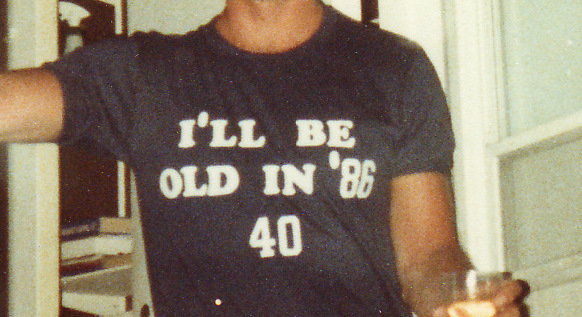
Does it feel a little weird?  Indeed.  But not because of the age itself… I’m really not (nor have I ever been) worried, scared or concerned about getting older.  No, it’s because of my memory of when my father turned 40.  I remember it well because I was almost 17.  [interesting background… when my aunt turned 40 – the year before my dad (her brother-in-law), she gave my dad a t-shirt that said “I’ll be old in ’86.  40.”  It was a great gift and is what, for me and my brothers, became the lasting image of our dad at 40… actually 39. ]

Dad at 40

It’s hard to believe that’s me now… actually a year ago.  When I think of when he turned 40, it’s not that he seemed old… it’s just that he seemed, I don’t know, older than I seem today.  I mean, come on, he was a father of three kids.  So am I.  But I still feel, in some ways, like I’m a young man.  Dad seemed way more responsible and mature than I am now.  He had to have been – he had 17-, 15-, and 13-year old boys.  My kids are 10, 8, and 5.

Knowing dad, he’d tell me he wasn’t any more mature or responsible (or father-like) than I am today.  Perspective is everything, right?  He’s my dad… he’ll always be the one with sage advice, wisdom and a great sense of humour.  That’s just the way it is.

I have my own children now who (just maybe) look at me the same way.  And you know what?  They don’t think I’m old.  Yesterday, I was told in no uncertain terms, by my 8-year old son, that I won’t be old for another 30 years.  Apparently, the age of 70 marks the point at which someone becomes a “geezer,” according to them anyway.  That’s good enough for me.

As I move ever closer to the top of the proverbial hill, it’s refreshing to know that I’m still 30 years from reaching the summit.  I guess to a child, their dad never seems too old (except maybe when they’re in their teens and battling about YOUR rules and THEIR independence)…

Whether it’s me remembering my parents at 40 or my kids looking at my wife and I today… 40 just isn’t old (I am resisting the many cliches I could use here… you’re welcome!).  And I’m looking forward to the next chapter.  i don’t know what it will bring but I do know it won’t be defined by my age… it’ll be defined by what I choose to do, why I choose to do it, whom I do it with and how I do it.  The last 40 have been great — the next 40 will be even better.

“When we get closer to deployment, we definitely need to start managing the change.”

I have heard this time and time again… And I’m sure you have too.  For many, this probably seems like a plausible approach.  After all, isn’t “change management” mostly about training as a means for being “ready” for the change?

The short answer is “are you kidding me?”.

This is one of the project world’s most common and perilous traps.  I tell all my clients that the process of managing change  actually starts before the project even kicks off.

Huh?  That’s right…

As soon as “change” is a sparkle in your eye, you better start managing it… the vision, the message, the context, the learning, the implementation itself, the transition, and the measurement…

Some think I’m cracked… but I’m right.  I would love to hear your opinions – what do you think?

“It’s the product, stupid”… or is it?

For the better part of a decade, I worked for a large technology company based in the greater Boston area.  When I joined in 1998, it was already a good size organization (~6,000 employees) with most of the power and influence being wielded out of two areas – Product Development (aka Engineering) and Sales.

The company was, first and foremost, a product company.  In large measure, we made great products and had a hell of a sales team that could close deals.   The road to product leadership had been paved primarily by a breakthrough product family that was a game changer and revolutionized the industry.  And the master mind behind that product line was revered like a god.  And rightly so, his design was instrumental in our ability to topple some of the world’s technology giants in the industry.

But… you can become too focused on how great your product is… In fact, I can remember being at a company “all-hands” meeting at which ‘said’ god was speaking.  He had just been named a fellow of the company and was giving a brief speech.  As he was finishing up, he raised his fist in the air (kind of pumped it) and said “it’s the product, stupid.”

What the hell does that mean?  I didn’t get it.  None of us (my contemporaries anyway) got it.  We just looked at each other with an “is-that-an-in-joke-that-none-of-us-are-in-on?” look.  Over the next couple days, we went looking for the reference… Clearly this had some meaning somewhere.  And it did.

We discovered that it had been a phrase used historically, in a “tongue-in-cheek” kind of way to explain why the company was so successful.  “It’s the product, stupid!”  How could you even ask the question… you idiot?!!  Ha ha ok I get it now.

At the time, I just found it lame… But upon some reflection, it really started to annoy me. (editorial note: I don’t believe there was any intent to offend anyone or even to be overly provocative… but it really got me thinking)

“It’s the product, stupid.”

“It’s the product, stupid.”

What about “the people?” What about you and me and everyone else?  Don’t we have something to do with the success of the company?

Don’t we have ideas that lead to new opportunities, initiatives, markets?  Don’t we conceive of products, design them, build them?  Don’t we market them, sell them, deliver them, and support them?…Heck — isn’t it people who BUY your products?

If your focus isn’t on people, how do you get anything right?

It’s the people, stupid.

<this event marked the beginning of my gradual shift toward a specialty in organizational leadership and change>

Picaroons – The Best Canadian Beer You’ve Never Heard Of…

We think we have a few secrets here in the Maritimes (New Brunswick, Nova Scotia, and Prince Edward Island, Canada). Small cities, great access to clean air and outdoor fun, lobster. I would add to that… some of the best beer you’ll find anywhere.

My favourite local beer is Picaroons (http://www.picaroons.ca).  I don’t know whether Picaroons is technically a craft beer or a micro brewery beer. And frankly I don’t really care. There’s a saying about art (something like – “I don’t know much about art, but I know what I like”). The same kind of applies to my knowledge of micro vs. craft beers. But I know I love this one.

Picaroons has a number of varieties. My “go to” summer choice is Dooryard, an Organic wheat beer (see below). It has a slight cloudiness to it and when you add a slice of lemon, the flavour explodes.

Picaroons Dooryard

[Backgrounder… it’s likely you’ve never heard the word dooryard.  In short, many folks in my neck of the woods use it as a synonym for driveway but here’s a proper definition (from the Carelton County New Brunswick Colloquialism dictionary… Dooryard \’dor-yard\ n – The exterior area of a home surrounding the most commonly used entryway, typically the driveway area; “Buddy does a good job of plowin’ out th’ dooryard.” A logical extension of “barnyard,” “back yard” and “front yard,” it is likely that this compound word grew out of a necessity to distinguish working areas from living areas. In a practice common to the region, homes were attached to barns and other out-buildings; dooryard identifies the exterior area of a home not given over to farming. A household word in parts of New Brunswick, dooryard is seldom heard elsewhere.  End of Back Story]

In the fall, I go back to two of Picaroons’ oldest (and I’m pretty sure original) beers – Best Bitter and Irish Red. Both of these are substantial ales with nice hoppy flavours. And if you love hoppy, try Yippee IPA! I’d be lying if I said I didn’t enjoy a nice stout in the winter like Guinness or St. Ambroise Oatmeal Stout (from Montreal). But I also like Picaroons’ Dark & Stormy Night. And when Spring Hits, I look for their Blonde Ale… tasty.

But today, when we were supposed to feel remnants of Hurricane Bill (and didn’t save for a few minutes of rain and wind), it was all about Dooryard.  There are lots of little gems out here in eastern Canada, especially in my home province of New Brunswick, also known as the picture province.  One of them is Picaroons… the best Canadian beer you’ve “now” heard of.

Do you have a sense of urgency?

Creating a sense of urgency is a necessity if you are to implement successful change in your business. Why? Well, for starters, a sense of urgency from a C-level sponsor creates the initial boost needed to give birth to a new initiative. That boost can help ensure the project kicks off on the right foot (strong sponsorship and commitment, proper funding, and the right resources dedicated to the project). It can also provide a kick in the pants where needed.

But most of all, in my experience, a sense of urgency creates energy. It creates an atmosphere that motivates people. It brings excitement. It creates something to connect to and gather around. A sense of urgency also inspires us to do something, to do it better, to do it smarter, to do it now!

Great — so how do you create a sense of urgency? I like to use business cases or cost-benefit analyses. Business leaders like, no scratch that, they need to understand the analytical rationale for agreeing to pursue something new — a new product, a new market, a new system, a new process… A business case helps you to articulate what’s happening in your business, what needs to change, how it ought to be changed, the benefits of doing it, and the costs to get there (giving you some semblance of an ROI). Granted, high-level estimates often leave much to be desired but a business case can get people excited… create belief in the story and form the basis for a sense of urgency to do something about it.

John Kotter, author of Leading Change and a pre-eminent authority on organizational transformation, believes (and I happen to agree) creating a sense of urgency is critical to successful change. The video below is a 2008 interview with Kotter in which he gives his insights on urgency and how to create it… Take a look.