
Common sense… but not so common

A few weeks ago, I was making a presentation to a group of colleagues… the topic was Change Leadership.

[Back story – I lead my consulting firm’s Change Practice. We implement strategies and tactics that help our clients realize the benefits of the changes (new systems, processes, structures, policies, etc.) they are making… You better underline benefits too because an awful lot of organizations forget about that. I know it sounds crazy but it’s true.

Many “change consultants” are psychology types that place emphasis on ensuring people are comfortable and empowered throughout major change because it can be so painful and disruptive. I agree it’s important to facilitate the change for the people impacted by it… but not because they feel pain and disruption… because if they are successful, you will achieve the benefits of the change. And if your people don’t succeed through a change, your organization and its performance won’t either.

It really isn’t so much about “managing change” but about “making change stick.” If it doesn’t stick, it’s a wasted investment… My practice is in the business of helping you do the right things in the right ways to ensure you don’t waste your investment. End of back story].

As we were nearing the conclusion of the session, I was reviewing some of the major building blocks of most change methodologies: vision, communication, education & training, operational transition. I put up a slide that said “Sounds like common sense… and that’s the problem.”

Communications and training sound so simple. And in many ways they can be, in concept, but they require a great deal of focus, skill and energy to do really well. And few organizations do these well. In fact, these are the most often cited areas that project teams and organizations would say they had a shortfall or underestimated the effort required. Yeah – no kidding!!

One of the fundamental reasons so many transformation (very overused term by the way, so my apologies) and change initiatives fail is because project sponsors and team leaders underestimate the work needed to properly engage and enable stakeholders (i.e. users, staff, workers or whatever word best describes the people who need to change).

So the next time you are considering change for your organization… don’t pay lip service to the building block activities I mentioned about – vision, communication, training, and operational transition. Really do them. And do them well. They are an investment. And they will pay off. Better yet – contact an expert who can help you do this (I could recommend someone!). Yes – this is totally self-serving… but look around… there are very few people who do this kind of work for a living.

Success is what you want… it’s what you need. Benefits are what you want to achieve. They’re what you need to achieve.

It seems like common sense, eh? (that’s Canadian for “right?”)… Well, it’s not that common. And that’s unfortunate for the organizations that represent the 2/3 of all change initiatives that fail to deliver their desired benefits. In fact, it’s a shame.
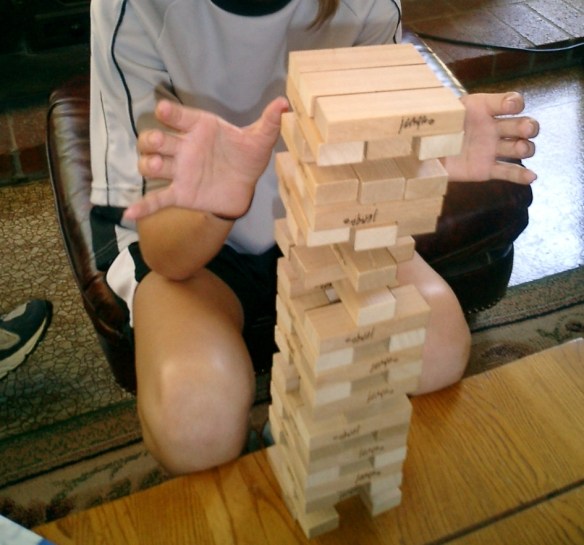

“You can’t play Jenga with a house of cards…”

It was a Friday in July of 2006; it was about 1pm on a hot and humid day in greater Boston.  I was just finishing my 12th consecutive month of weekly travel (and feeling a little irritable).  I was the change leader for a very large CRM implementation.  Bill was the Program Director, Bob was the Business Lead and Tony was the Partner from our integration partner.  “You can’t play Jenga with a house of cards,” remarked Bob… (reminder below)

Jenga

The back story… We were in month 16 of an 18-month odyssey to bring a new CRM system to 5000 professionals located in every corner of the world.  In many ways, the project was a success story.  We had strong sponsorship.  We had (mostly) adequate funding.  We had (moderately) a solid team.  We had excellent engagement and commitment from stakeholders, especially from our field organization (probably the best I’ve ever been involved with).  System development, on the other hand, had been bumpy; forever behind schedule.

On the Friday morning before we’re scheduled to kick-off end-user training in London and Munich… we’re notified that our training environment (shoddily built by the way) has crashed.  They’re confident they can get it back online in time for training on Monday.  What do you do?  (note: this was not the first environment issue this project had experienced).

The discussion we’re having is (A) what to do about next week and (B) what to do… period… about training.  Our training program was developed on a model of direct practice in the system.

“You can’t play Jenga with a house of cards.”

The system and its instability was the house of cards…

I was extremely “bearish” on this system.  Had been for some time.  There was always something problematic with it… And we’d gotten a big black eye during our train-the-trainer program when we reluctantly used the development environment to conduct hands-on training. I had the pleasure of being in a classroom full of senior folks in Paris when our system crapped out.  Sorry doesn’t really cut it.

As the leader of the change team, the front line to the users, my team and I were feeling the wrath of anxious users who’d been burned by IT projects before.

So what did we do?…We cancelled the next week’s training… another mis-step would have erased what little confidence our users had in the system.  As I said, they’d been burned before by past projects.  That would have been a disaster for the $30M program.

Early the next week, after 72-hours of work by our tech team, we made what would turn out to be the best under pressure decision we made on the project.  While our tech guys were saying “everything should now be fine,” we weren’t convinced.  We scrapped the entire 5-week training program and set out on a plan “B”.  In short — 2 words: do over.

We replaced an instructor-led, classroom-based model with a completely web-based program.  In the span of a few days, we developed a “good enough” product to bring to the masses.  And build a new support model to provide coaching and assistance — user-led training isn’t as rich in content so we expected more support would be needed by our users.

It was a tremendous collaborative effort between business people, subject matter experts, IT folks, our trainers, extended project team, power users and our core team.  And, to paraphrase my now “former” brother-in-law… “it all worked out.” (it didn’t for him… hence the “former“).

Reasons for success:  (1) we gathered as much information as we could in the short time we had, (2) we were rational about what “could” be done – we did not try to be heroic (like many project teams do when faced with a critical issue), (3) we were honest with our stakeholders about what happened and how we would fix it (and we apologized to them for the inconvenience our issues had caused them and their teams), (4) we worked day and night to make it right, and (5) we thanked and rewarded the team of people who made it happen.  I had a lot of thank yous to our process leads, their teams, our consultants, and my team…

As with anything related to change – you have to put people first.  If you do that, and always do it, a lot of good things fall into place.  And while you still have a lot of work to do, you’ve got people working together toward the goal.

Food: the universal language

One of the most popular ways for people to find common ground is over a nice meal. When we are trying to build rapport and relationships with prospective customers, we arrange a great dinner meeting. When we’re trying to impress that new girl (or boy) friend, we reserve the best seat in the house and the city’s hottest restaurant. When we’re trying to comfort someone, perhaps during a time of loss, we cook for them.

Yes, food is a catalyst for great conversations and memorable moments. Don’t under-estimate the power of food in the workplace either. When you’re in the middle of a tough project, one that has few good days and many bad ones (we’ve all been there), nothing brings a team together like a good meal at a great locale. It’s the social aspects of eating together that leads to break-throughs… we relax when we’re eating and drinking. And when resistant stakeholders’ guard is down, that’s when you really make progress. Pretense is gone and posturing is off-duty.

Of course, it’s more than just resolving differences or problems or tearing down walls… just showing up some morning with bagels and coffee or fruit and yogurt puts smiles on people’s faces. Why? No matter the situation, we all (well, most of us anyway) feel good when someone does something for us… shows some appreciation to us. It means a lot. Often, the smaller, more random acts mean the most. So the next time you’re in a bind with a customer, a colleague, a staff member, a boss, a friend or a family member… bring food. Sure you can always pick up the phone (we don’t do that enough anymore) but after that… show up with food.

By the way, speaking of food… tonight we made homemade pizzas for supper (does the word supper make me sound like a Canadian?… I hope so!!). We got the idea from our friend Cheryl and her blog 5 second rule (http://5secondrule.typepad.com/my_weblog/2009/07/how-to-make-a-tortilla-pizza.html). She had a great recipe for a simple six ingredient tortilla pizza.  We improvised a bit based on what was in the kitchen (pitas for the kids)… Our six were tortillas, mozzarella, fresh tomatoes, fresh basil, scallions, olive oil… The result: delish! (thanks C. — here’s a pic… not as professional as yours but you get the idea).

Our Six

Our Six

What did I say about food? It puts smiles on faces… and a simple pizza even does the trick. It worked for us.

“We don’t hire consultants for advice.”

If not… why do you hire them?  For their good looks and their bargain basement prices?  The rest of this statement was “we hire them to deliver (what we asked for).”  Ouch!

I’ve been in consulting (in some form or another) for most of my career and I can appreciate what a client is thinking when he says he just wants someone to deliver what he’s asking for.  Too often, consultants swoop in wearing their $1200 suits, conduct some high-level interviews, leave a 50,000-foot report on the table and fly off (collecting their air miles as they go) to the next one.  It’s unfortunate that consultants are generally painted with the “we don’t do what we propose” brush (remember the UPS commercial?).

So, yes, there is all kinds of fun to be made of the “consultant.”  However, in my experience (and I suspect yours as well), clients usually don’t really know what they need because they seldom have the people or take the time to analyze their situation and develop a real case for doing something.  And to implement real, lasting change, you need to have a good rationale for it in the first place… Otherwise, you’ll be the hamster on his little wheel thingy… spinning your wheels… spending lots of money on, well, who know.  Now that’s a shame.

Anyone can hire an implementation specialist to come in and do what you say.  But if you’re wrong, you’re SOOL.  A good consultant will provide you insights based on solid analysis of your problem(s) and their experience with similar problems in different organizations.  That can be incredibly valuable.

So the next time you’re simply looking for a body-shop to provide a coupla drones to carry out your latest order, take a moment to be sure YOU know what you need.  Otherwise, you will not win… and it’ll become something else you blame on the consultants.  You may not want their advice but you certainly need it.